
D’Addario XSAPB1253-B25 Phosphor Bronze Acoustic Guitar Strings – 25 Sets
★★★★★ 4.9 Stars — Over 1,500 Google Reviews
Original price was: $549.00.$475.00Current price is: $475.00.
FAST
Delivery
EASY
Returns
IN HOUSE
Repairs



Pick-up from store - FREE
Free pickup from our Melbourne Store at 4 Drake Boulevard, Altona VIC 3018. Your order will typically be ready by the next business day. We recommend calling us on (03) 8360 7799 beforehand to check it's ready for collection.
International Shipping
Please proceed to checkout to see international rates and avalability.
D'Addario XS Phosphor Bronze Acoustic Guitar Strings — Light 12-53 — 25-Set Bulk Pack
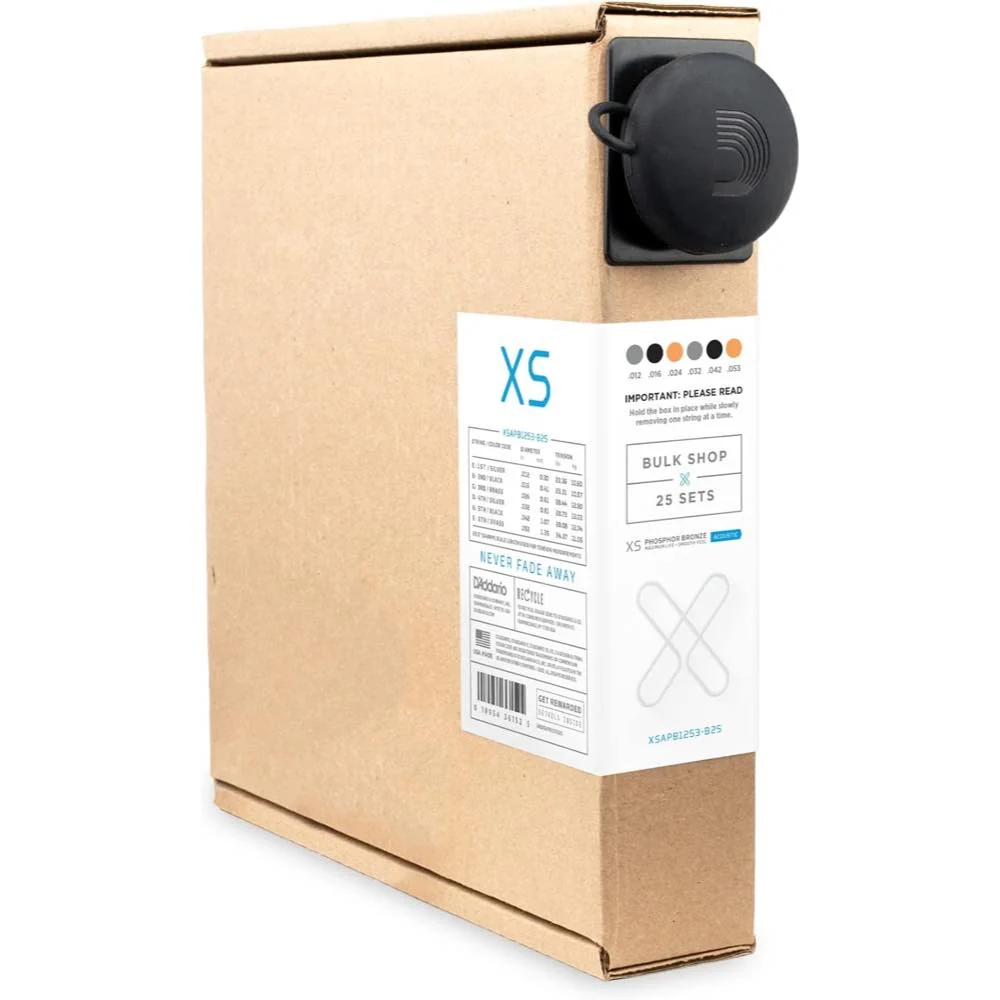
The D'Addario XSAPB1253-B25 is a bulk pack of 25 sets of XS Phosphor Bronze acoustic guitar strings in light gauge (12-53). XS is D'Addario's highest-specification coated string line, built around an ultra-thin film coating on every wound string and a unique polymer treatment on the plain steel strings — a different approach from conventional coated strings that delivers maximum protection with a feel and tone that is closer to an uncoated string than any previous D'Addario coating. The 25-set format suits gigging players, teachers, music schools and anyone who changes strings regularly and prefers to buy in volume.
★ Expert Insight — Why XS Coating Is Different from Standard Coated Strings
Coated strings have been on the market for decades, but the traditional approach — applying a polymer sleeve over the entire string — creates a trade-off: the coating extends string life but adds a layer between the player and the string that many find slippery or tonally dulling. The coating also sits proud of the windings, which can feel rough where it wears at contact points over time.
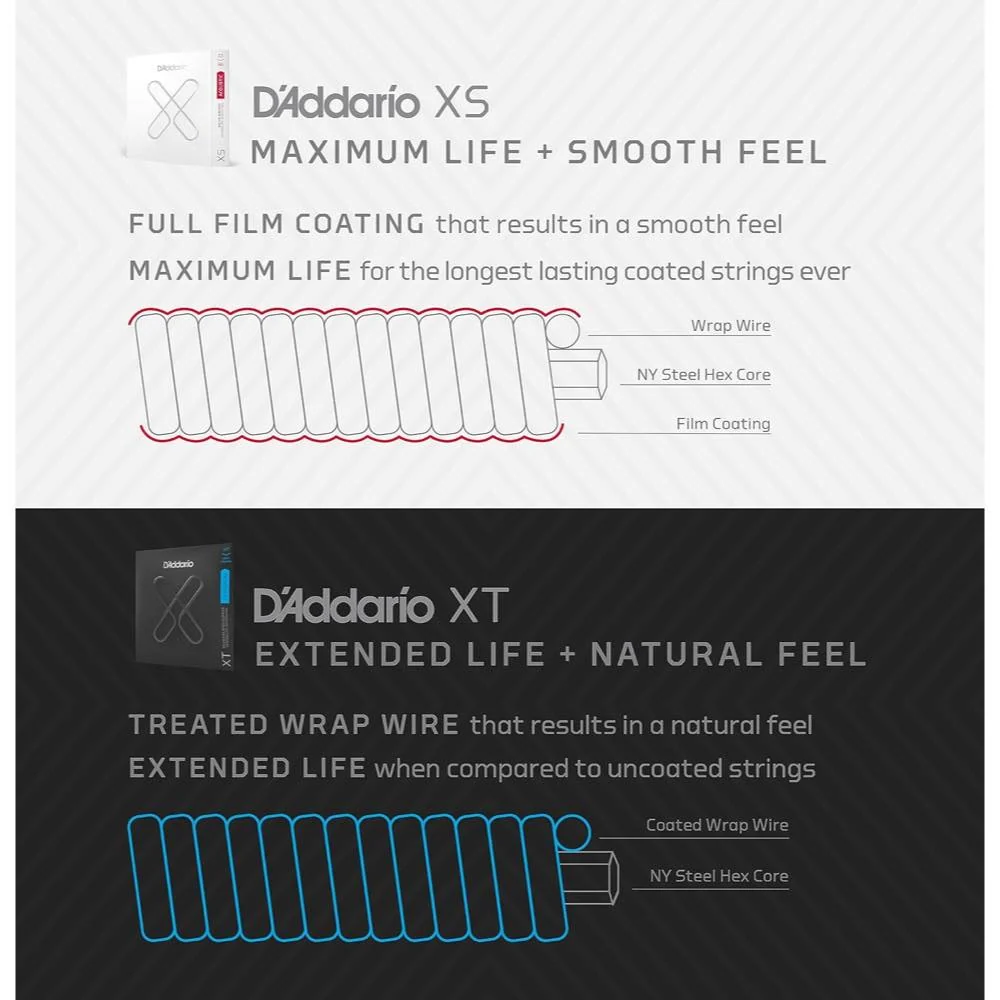
D'Addario's XS technology applies an ultra-thin film coating directly into the micro-gaps between the string windings rather than over the top of them. The result is a surface that feels like a quality uncoated string — the string's natural texture is preserved — while the winding material itself is protected from the sweat, oils and humidity that degrade ordinary strings. On the plain steels, where wound-string coating cannot be applied, a proprietary polymer treatment addresses oxidation differently. The combination produces strings that sound like new for significantly longer than uncoated alternatives, without feeling like coated strings.
XS Ultra-Thin Coating — What It Does and How
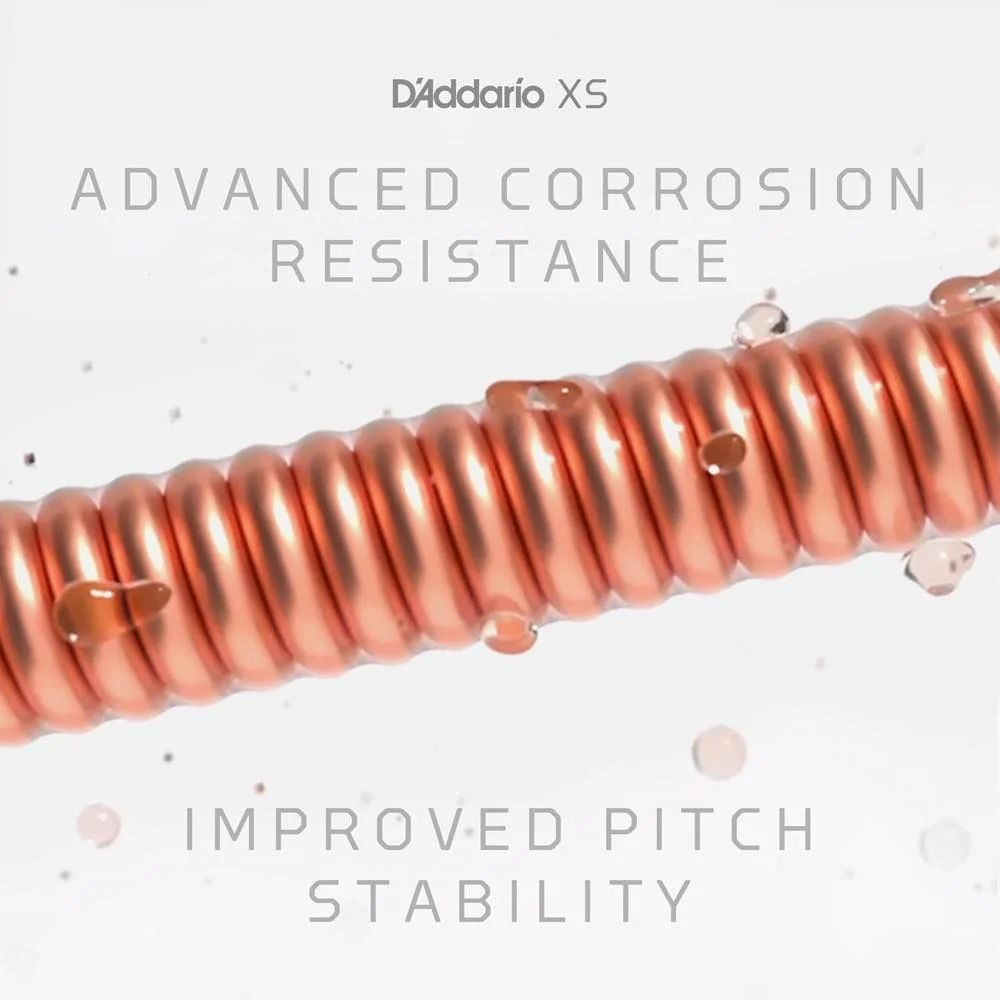
Acoustic strings fail in two distinct ways: the wound strings corrode as sweat, skin oil and environmental humidity penetrate the gaps between the windings and attack the underlying metal, and the plain steels oxidise from surface exposure. Standard coated strings address the first problem but often address it crudely, applying a polymer sleeve thick enough to be perceptible in feel and to alter the string's vibration profile slightly.
The XS coating is thin enough that it does not sit above the winding profile. Under the finger it feels like metal rather than plastic. The protective benefit is the same — the film seals the micro-gaps between windings against contamination — but the tonal penalty is removed. D'Addario's testing shows XS strings maintain their frequency response across significantly more playing hours than an uncoated Phosphor Bronze string of equivalent specification, while delivering an initial tone that is indistinguishable from uncoated in controlled tests.
The plain steels in the XS set receive a polymer treatment rather than a film coating — because plain steels vibrate as a uniform cylinder and even a thin coating affects their mass and response in ways that wound strings, with their larger diameter and different vibration geometry, do not. The polymer treatment addresses surface oxidation without altering the string's diameter or feel.
Phosphor Bronze Winding — Warm, Balanced, Long-Lasting
Phosphor Bronze is an alloy of copper, tin and a small percentage of phosphorus. In acoustic string winding, the phosphorus serves two functions: it hardens the alloy slightly for better wear resistance, and it acts as a deoxidising agent that slows the alloy's own oxidation process. This means Phosphor Bronze wound strings resist corrosion better than standard 80/20 Bronze (copper and zinc) even before any coating is applied.
Tonally, Phosphor Bronze strings are warmer and more balanced than 80/20 Bronze, with a richer low-mid response and less of the bright, almost metallic edge that 80/20 produces when new. They are well matched to steel-string acoustic guitars of most body styles — particularly guitars with cedar or mahogany-topped bodies where 80/20 Bronze might push the high frequencies further than the guitar's natural voicing suits. On spruce-topped guitars the warmth of Phosphor Bronze typically produces a balanced tone without the harshness that 80/20 can bring to a bright spruce top in the first weeks of string life.
The XS coating on the Phosphor Bronze windings extends the life of this tonal characteristic significantly, preserving the string's initial warmth and brightness rather than allowing them to dull as contamination builds in the windings.
NY Steel Core and Fusion Twist Technology
D'Addario draws its NY Steel core wire at its factory in New York from high-carbon steel to a proprietary specification. The consistency of the draw process — diameter tolerances, surface finish, steel composition — is tighter than commodity string steel, which translates directly to more accurate pitch, better intonation across the neck and more predictable tuning stability. NY Steel strings have greater break strength than standard string steel at equivalent gauge, which reduces breakage at the ball end, saddle and nut — the three points where string failure is most common.
Fusion Twist is D'Addario's proprietary ball-end construction method. The ball end is the brass ferrule at the tail of the string that anchors in the bridge. In a standard string, the steel is twisted around this ferrule by a mechanical process that leaves the attachment point subject to micro-movement under repeated string cycling. Fusion Twist fuses the twist into the ball-end attachment with a process that creates a more secure, permanent bond. The result is a ball end that does not slip or work loose over the string's life, contributing to tuning stability — particularly important when restringing a bridge-pin acoustic, where the ball end takes significant load on each tuning.
Light Gauge 12-53 — Who It Suits
Light gauge strings (12-53) are one of the most widely used acoustic string gauges across all playing styles. The reduced tension compared to medium gauge (13-56) makes fretting and bending easier, and the lighter load on the guitar top allows a more sensitive acoustic response — lighter gauge strings let the guitar resonate more freely, which can produce a more open, detailed sound on instruments with responsive tops.
The trade-off is lower volume and projection than a medium gauge string when played hard, and less of the tight, punchy low-end that heavier gauges provide. For the majority of fingerstyle playing, singer-songwriter strumming, recording applications and day-to-day practice, light gauge is the right balance between playability and acoustic performance. Players with smaller hands, developing calluses or tendon/repetitive strain concerns will find light gauge substantially more comfortable over long sessions than medium. Guitar teachers frequently keep light gauge strings on student instruments for the same reason.
25-Set Bulk Pack — Value for Regular String Changes
The B25 (25-set) format is designed for players, teachers and music schools whose string consumption makes single-pack purchasing inefficient. A bulk pack delivers a significantly lower per-set cost than buying individual sets, and having a stock on hand removes the disruption of a mid-session or mid-tour string change without a replacement available.
Gigging acoustic players who change strings before every performance or every week of shows will typically go through 50 or more sets per year. Teachers who restring student instruments regularly — particularly where students are still developing technique and breaking strings — find a 25-set stock eliminates frequent reordering. Music schools and rehearsal studios benefit from the same economy of scale.
Because XS strings retain their tone for significantly longer than uncoated strings, a player who previously changed strings every two to three weeks may find XS extends that interval to four to six weeks or longer without the tone deteriorating to the point of needing replacement. This changes the economics of coated strings: the higher per-set cost of XS relative to uncoated strings is offset by the reduced frequency of changes.
Who Is the XSAPB1253-B25 For?
The XSAPB1253-B25 is for acoustic guitarists who play regularly, care about tone consistency across string life and want to buy in volume. The XS coating is particularly well suited to players whose strings degrade quickly — whether due to high-acid perspiration, regular gigging or simply extended playing hours — and who have previously found coated strings unsatisfying in feel or tone. Players who have been using Elixir Nanoweb or similar strings and are happy with coated string life but find the feel too slippery or the tone slightly dulled should try XS; the coating approach is genuinely different. The 25-set volume suits professional gigging players, touring musicians, guitar teachers, music schools and any player who regularly stockpiles strings.
Specifications
| Feature | Specification |
|---|---|
| SKU | XSAPB1253-B25 |
| Product | D'Addario XS Phosphor Bronze Acoustic Guitar Strings |
| String Type | Coated Phosphor Bronze wound / Polymer-treated plain steels |
| Gauge | Light — .012, .016, .024, .032, .042, .053 |
| Core Material | NY Steel (D'Addario proprietary high-carbon steel) |
| Winding Material | Phosphor Bronze |
| Coating Technology | XS ultra-thin film (wound strings) + polymer treatment (plain steels) |
| Ball End Technology | Fusion Twist |
| Pack Size | 25 sets (B25 bulk pack) |
| Instrument Type | Steel-string acoustic guitar (standard tuning) |
| Made in | USA (D'Addario, Farmingdale, New York) |
Questions About String Choice?
If you're not sure whether XS Phosphor Bronze is the right match for your guitar or playing style — or you want to compare XS against other D'Addario lines — come in or give us a call. We've got the full D'Addario range in stock and we're happy to talk through string selection for your instrument and how you play.
Frequently Asked Questions
How do XS strings compare to Elixir Nanoweb?
Both are coated strings designed to extend string life, but the coating approaches differ. Elixir's Nanoweb applies a polymer web over the entire string surface — wound and plain alike — which gives a consistent feel across the set but one that many players describe as slippery or plasticky. The XS coating is applied differently: a thin film into the winding micro-gaps on the wound strings, and a polymer treatment (not a film) on the plain steels. In practice, XS strings feel closer to an uncoated string in texture — the individual windings are still slightly perceptible underhand rather than covered by an even film. Players who have tried coated strings and disliked the feel often respond better to XS. Tonally, the difference is subtle in controlled listening but XS is generally perceived as brighter and more articulate at first play than Elixir Nanoweb, which has a slightly warmer character due to the thicker coating dampening some upper harmonics.
How long do XS strings actually last compared to uncoated strings?
String longevity depends heavily on the individual player's body chemistry, playing frequency, and storage. Players with high-acid perspiration can degrade uncoated strings in a single session. As a general benchmark, an uncoated Phosphor Bronze set played for an hour or two daily might need changing after two to three weeks before the tone noticeably deteriorates. D'Addario's own testing and player reporting consistently show XS strings retaining their tone at three to five times that interval — four to eight weeks or longer is common — while continuing to feel smooth throughout. The coating protection applies from the moment the string is installed, so even players who are light on sweat will see the tonal shelf life extended.
Is 12-53 light gauge suitable for fingerstyle playing?
Yes — 12-53 is one of the most commonly used gauges for fingerstyle. The lower tension compared to medium gauge (13-56) makes the strings more responsive to the lighter dynamic range of fingerpicking, allowing the guitar's top to move more freely and producing a more detailed, nuanced acoustic tone. Fingerstyle players who need strong projection for solo performance sometimes use medium gauge for the additional volume and low-end firmness, but for the majority of fingerstyle applications — recording, ensemble playing, accompanied singing — light gauge is well suited. Players coming from medium gauge who try 12-53 on the same guitar typically notice it feels significantly easier to play and may also notice increased treble clarity.
Can I use XS strings on a guitar with a bone saddle or nut?
Yes. The XS coating does not cause any additional wear on bone, synthetic bone (Tusq), plastic, Graph Tech or other standard nut and saddle materials. The coating is thin enough that string-to-slot geometry is not meaningfully affected. If you have had issues with coated strings sticking in nut slots (a problem with thicker coating types that can bind in tight slots), XS is less prone to this due to the thinner coating profile. Standard maintenance — keeping nut slots clean, using pencil graphite or nut lubricant if a slot shows friction — applies as normal.
Is the 25-set bulk pack a good option for a music school or teaching studio?
It's the format the bulk pack is designed for. A teaching studio that restrings student instruments regularly — whether due to string breakage, long intervals between student home practice and studio sessions, or simply maintaining instruments at their best — will find the B25 format significantly more economical than buying individual or three-set packs. The XS coating also means strings can be left on student instruments for longer intervals without tonal degradation, reducing the frequency of restringing across the fleet. For a studio with five or more acoustic instruments that students use daily, a 25-set annual supply is a realistic quantity.
Using XS strings on your acoustic? We'd love to know what you think.
Leave us a Google Review — it helps other musicians make better choices.
Additional information
| Weight | 0.15 kg |
|---|---|
| type | Acoustic |
| Modified Item | No |
| Custom Bundle | No |
| Non-domestic Product | No |
| Product Type | Strings |
| suitable for | Acoustic Guitar |
| Instrument Family | Guitar |
Related Items & Accessories
Related products
-
12% OFF
RRP $26.00
Save $3.00
Sale!
 SKU: DDT7_1056
DR Drop-Down Tuning DDT Electric Guitar String Set 7-String 10 – 56
Original price was: $26.00.$23.00Current price is: $23.00.In Stock -
 SKU: 500AR
Savarez 500AR Corum Alliance Classical Guitar Strings Normal Tension
$44.00On backorder -
20% OFF
RRP $49.00
Save $10.00
Sale!
 SKU: EXL120-3P
D’Addario EXL120-3D Nickel Wound Electric Guitar Strings, 9 -42 – 3 Sets
Original price was: $49.00.$39.00Current price is: $39.00.In Stock -
16% OFF
RRP $769.00
Save $120.00
Sale!
 SKU: 78980
Pirastro Obligato 4/4 Cello Strings Medium Tension String Set
Original price was: $769.00.$649.00Current price is: $649.00.In Stock -
5% OFF
RRP $38.95
Save $1.95
Sale!
 SKU: SB113
Thomastik-Infeld Spectrum Bronze Acoustic Guitar Strings – Medium .013-.057
Original price was: $38.95.$37.00Current price is: $37.00.Out of stock