
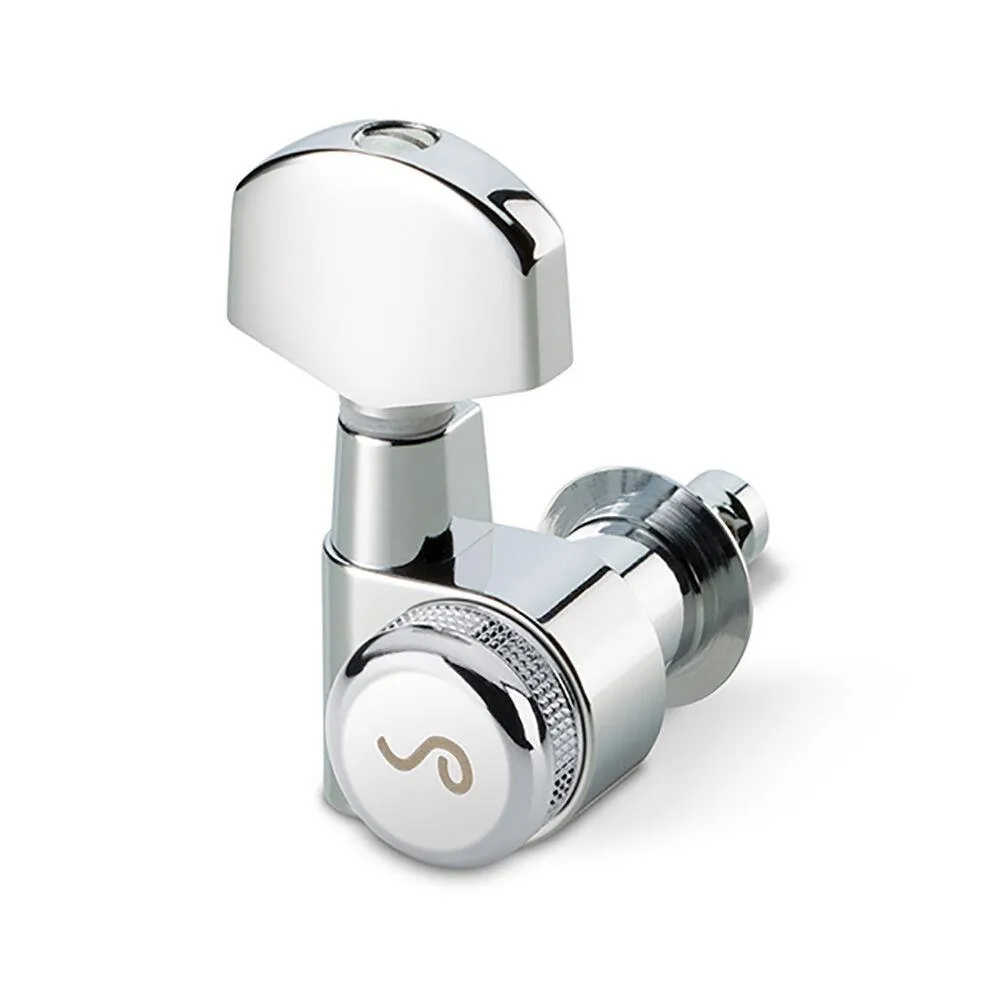
Schaller Guitar Machines 3/3-Chrome M6 – Pin – Set of 6
★★★★★ 4.9 Stars — Over 1,500 Google Reviews
Original price was: $369.00.$325.00Current price is: $325.00.
FAST
Delivery
EASY
Returns
IN HOUSE
Repairs



Pick-up from store - FREE
Free pickup from our Melbourne Store at 4 Drake Boulevard, Altona VIC 3018. Your order will typically be ready by the next business day. We recommend calling us on (03) 8360 7799 beforehand to check it's ready for collection.
International Shipping
Please proceed to checkout to see international rates and avalability.
Schaller M6 Pin Locking Tuners — 3/3 Chrome, Set of 6 (SKU: 45450P)
The Schaller M6 Pin is the original locking tuner — the product that Schaller invented, patented and has refined over more than twenty years as the benchmark locking tuner in the guitar world. This set of six in 3/3 configuration with chrome finish uses Schaller's patented ball socket pin lock system — locking the string with a knurled nut at the rear of the peghead for a low overall profile and a string change process that takes seconds rather than minutes. Gear ratio 1:18. At Angkor Music Melbourne we carry the largest range of Schaller hardware in Australia — if you need a specific Schaller configuration, we have it.
Angkor Music — Australia's Premier Schaller Stockist
We stock more Schaller hardware than any other retailer in Australia — tuning machines, strap locks, bridges, tremolo systems and accessories across the full Schaller range. When a customer needs a specific Schaller configuration — a particular finish, button style, shaft length or headstock drilling pattern — we have it. Schaller hardware is German-made to tolerances that mass-produced import alternatives cannot match, and the M6 locking tuner in particular is the product that defined what a locking tuner should be. If you have questions about which Schaller tuner suits your specific guitar, our team is happy to advise before you purchase.
Schaller Invented the Locking Tuner — The History Matters
Schaller was the world's first manufacturer to develop and patent the locking tuner — a claim that matters because it means every other locking tuner on the market is working from Schaller's original concept. The locking tuner was not a solution that emerged simultaneously from multiple manufacturers — it was Schaller's invention, patented more than twenty years ago and refined continuously since.
When you purchase a Schaller M6 Pin you are buying the original — the product that established what a locking tuner does and how it should work. Other manufacturers have produced versions of the locking tuner concept, some at lower price points. None of them are the original.
How the Pin Lock System Works
The Schaller M6 Pin uses a ball socket principle for string locking — different from the cam-and-clamp systems used on many other locking tuners and significantly more effective at preventing string notching and breakage.
The installation process is straightforward:
- Thread the string through the tuner shaft hole as you normally would
- Tighten the knurled nut located on the rear of the peghead — this activates the pin lock mechanism and secures the string
- Tune to pitch — no winding is required
The string is not wound onto the shaft — it is locked in place and tuned directly. This produces two significant practical benefits:
- Faster string changes: Without winding, a complete restring takes a fraction of the time of a conventional tuner installation. On a guitar that is regularly restrung for gigs or recording sessions this is a meaningful practical advantage.
- Superior tuning stability: String windings on conventional tuners are one of the primary causes of tuning drift — each winding is a potential slip point. With no windings, the string goes from locked to tuned to stable with maximum reliability. For non-locking tremolo systems — Bigsby, vintage Fender tremolo, Gotoh 510 — this is particularly significant, as the tuning stability of the whole system depends on the string not slipping at the tuner.
Ball Socket Principle — Preventing String Notching and Breakage
Schaller's patented ball socket locking principle is specifically designed to prevent string notching and breakage at the tuner — one of the most common points of string failure on guitars with locking tuners that use cam-and-clamp or similar mechanisms.
When a string is clamped under high lateral pressure — as in some locking systems — the clamp mechanism creates a stress point in the string at the clamp edge. Over time and with repeated tuning movement this stress point develops into a notch and eventually a break. The ball socket principle distributes the locking force differently — securing the string without creating the lateral stress that causes notching. The result is a locking mechanism that is both more secure and gentler on strings than competing designs.
Low Profile Design
The knurled locking nut is located on the rear of the peghead — not on the face of the tuner button or barrel. This design keeps the overall height of the tuner installation low and unobtrusive, maintaining the visual profile of the headstock without the additional height that some locking tuner designs add. The M6 Pin installs cleanly and looks like a quality conventional tuner from the front while providing full locking functionality from the rear.
3/3 Configuration — Standard Guitar Headstock
The 3/3 configuration — three tuners per side — is the standard for most acoustic and electric guitar headstocks including Les Paul, SG, ES, most acoustic guitars and all guitars with a symmetrical three-per-side headstock layout. This set includes six tuners configured for three-per-side installation.
Confirm your headstock configuration before ordering: This is a 3/3 set — three tuners per side for standard symmetrical headstocks. If your guitar has a 6-in-line headstock (all six tuners on the same side — Fender Stratocaster and Telecaster style) you need the 6-in-line version of the M6. Contact us if you are unsure which configuration suits your guitar — we stock both and can confirm the correct model.
Specifications
| SKU | 45450P |
| Brand | Schaller |
| Model | M6 Pin |
| Type | Locking Tuning Machine |
| Configuration | 3/3 (Three per side) |
| Quantity | Set of 6 |
| Finish | Chrome |
| Lock System | Pin Lock — Ball Socket Principle (2 pins) |
| Lock Location | Knurled nut — rear of peghead |
| Gear Ratio | 1:18 |
| Shaft | Standard |
| String Winding Required | No |
| Suitable For | 3/3 headstock guitars — Les Paul, SG, ES, acoustic, classical-style |
| Not Suitable For | 6-in-line headstocks (Strat, Tele style) — different model required |
| Origin | Germany |
Expert Advice at Angkor Music
At Angkor Music Melbourne we carry the most comprehensive range of Schaller hardware in Australia — tuning machines, strap locks, bridges and accessories across every finish, configuration and model. If you have questions about which Schaller tuner is correct for your guitar — headstock drilling, bushing size, shaft length or button style — contact us before ordering and our team will confirm the correct specification.
★★★★★
4.9 Stars — Read Our 1,600+ Google Reviews →
Frequently Asked Questions
What is the difference between the M6 Pin and other Schaller M6 locking tuner models?
The M6 range includes several variants — the Pin lock (this model), the 135 and the Mini. The Pin lock uses Schaller's patented ball socket pin locking mechanism operated by a knurled nut at the rear of the peghead. Other variants in the M6 range use different locking mechanisms or are designed for different headstock profiles. We stock all M6 variants — contact us if you need help choosing the correct model for your specific guitar.
Will these fit my Les Paul or SG?
The 3/3 configuration suits most Les Paul and SG style guitars. However tuner fitting also depends on the peghead bushing hole diameter and the screw hole positions. Most Epiphone and Gibson Les Pauls use standard bushing and screw hole specifications that the M6 fits directly. Contact us with your guitar's make and model and we can confirm fitment before you order.
Do I still need to wind the string at all?
No — this is the primary advantage of the M6 Pin. The string is inserted into the shaft hole, the knurled nut is tightened to lock it, and the string is tuned to pitch from there. No winding is required at all. The string does not wrap around the shaft — it is locked in place and tuned directly. This is what produces the superior tuning stability and faster string change time.
Why are locking tuners particularly useful for non-locking tremolo systems?
On a guitar with a non-locking tremolo — such as a Bigsby, a vintage Fender tremolo or a Gotoh 510 — the string can slip at any of its contact points when the tremolo is used. String windings on the tuner are one of the most common slip points. With the string locked at the tuner and not wound at all, one of the major causes of tremolo-induced tuning instability is eliminated. Locking tuners are the single most effective upgrade for improving the tuning stability of a non-locking tremolo system.
What is the gear ratio of 1:18 and why does it matter?
The gear ratio indicates how many turns of the tuner button are required to produce one full rotation of the tuner shaft. A 1:18 ratio means eighteen turns of the button produce one full shaft rotation — giving very fine, precise tuning control. A higher gear ratio produces finer adjustment. 1:18 is a professional-grade ratio that allows accurate tuning without overshooting.
Do you stock other Schaller tuner configurations and finishes?
Yes — Angkor Music stocks the most comprehensive range of Schaller hardware in Australia including all M6 configurations, finishes and button styles. If you need a specific Schaller tuner that you do not see in our online store, contact us and we will confirm availability.
Additional information
| Weight | 0.31 kg |
|---|
Related Items & Accessories
Related products
-
23% OFF
RRP $324.00
Save $75.00
Sale!
 SKU: 45121
Schaller Machines 6-in-L – Locking F-Series Tuners – Satin Chrome – SC501073
Original price was: $324.00.$249.00Current price is: $249.00.Out of stock -
11% OFF
RRP $236.00
Save $26.00
 SKU: 45301
Schaller Bass Machines 4/L M4 180 Light Nickel – 10300101.22.70
Original price was: $236.00.$210.00Current price is: $210.00.In Stock -
8% OFF
RRP $345.00
Save $26.00
 SKU: 45081
Schaller Machine Heads M6 Mini 6-in-L – Black
Original price was: $345.00.$319.00Current price is: $319.00.In Stock -
6% OFF
RRP $449.00
Save $29.00
 SKU: 45070
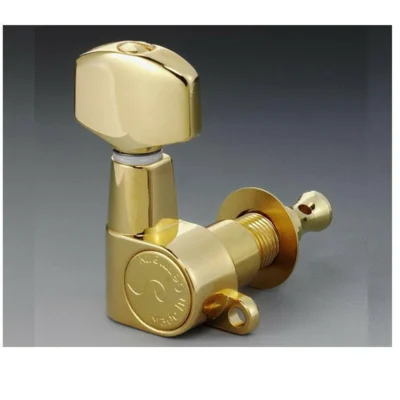
Schaller Machines 3/3 M6-Mini Gold – Set of 6
Original price was: $449.00.$420.00Current price is: $420.00.In Stock -
5% OFF
RRP $310.00
Save $15.00
 SKU: 45020
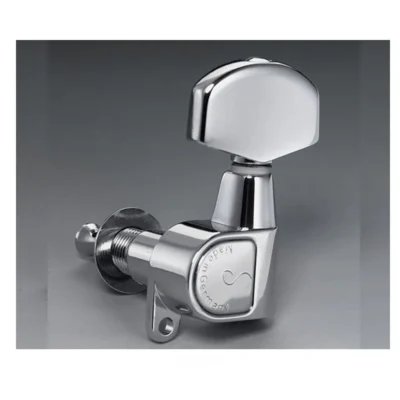
Schaller Guitar Machines 3/3-Chrome M6 Set of 6 – 3 left 3 Right Tuners
Original price was: $310.00.$295.00Current price is: $295.00.In Stock