
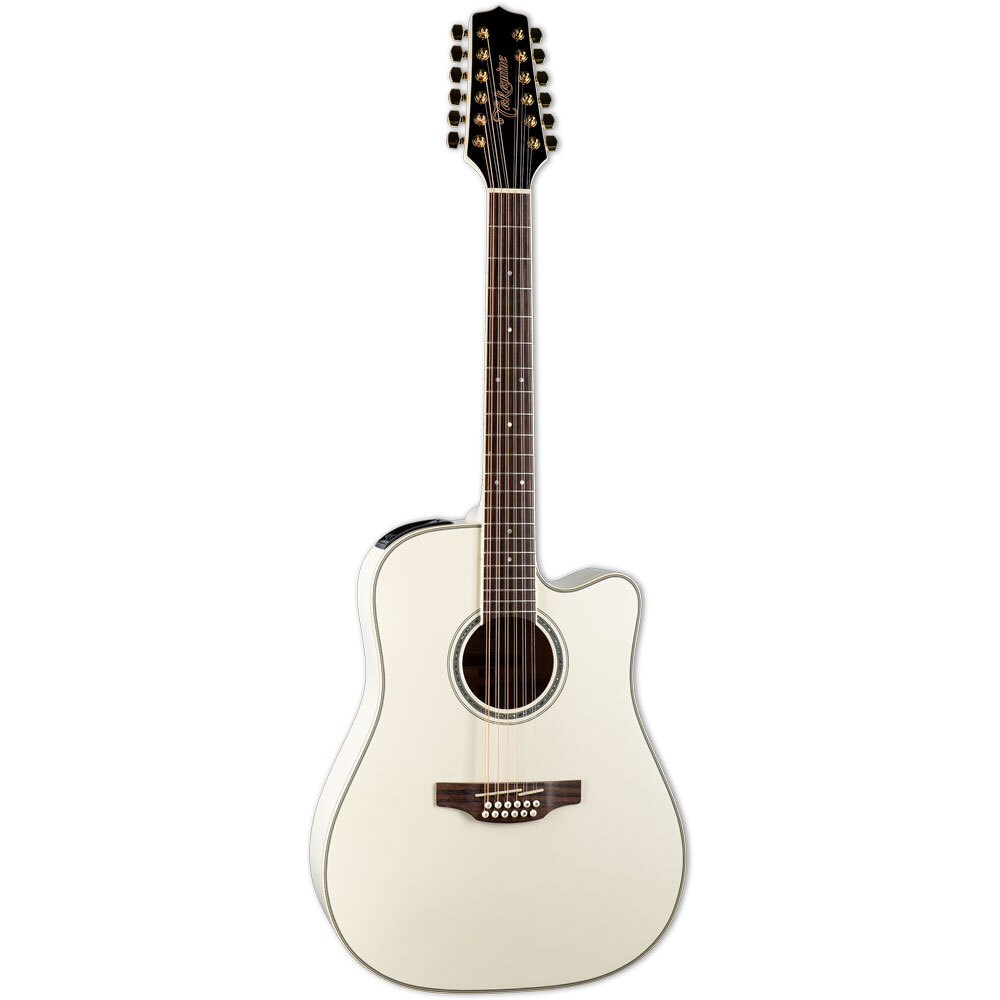
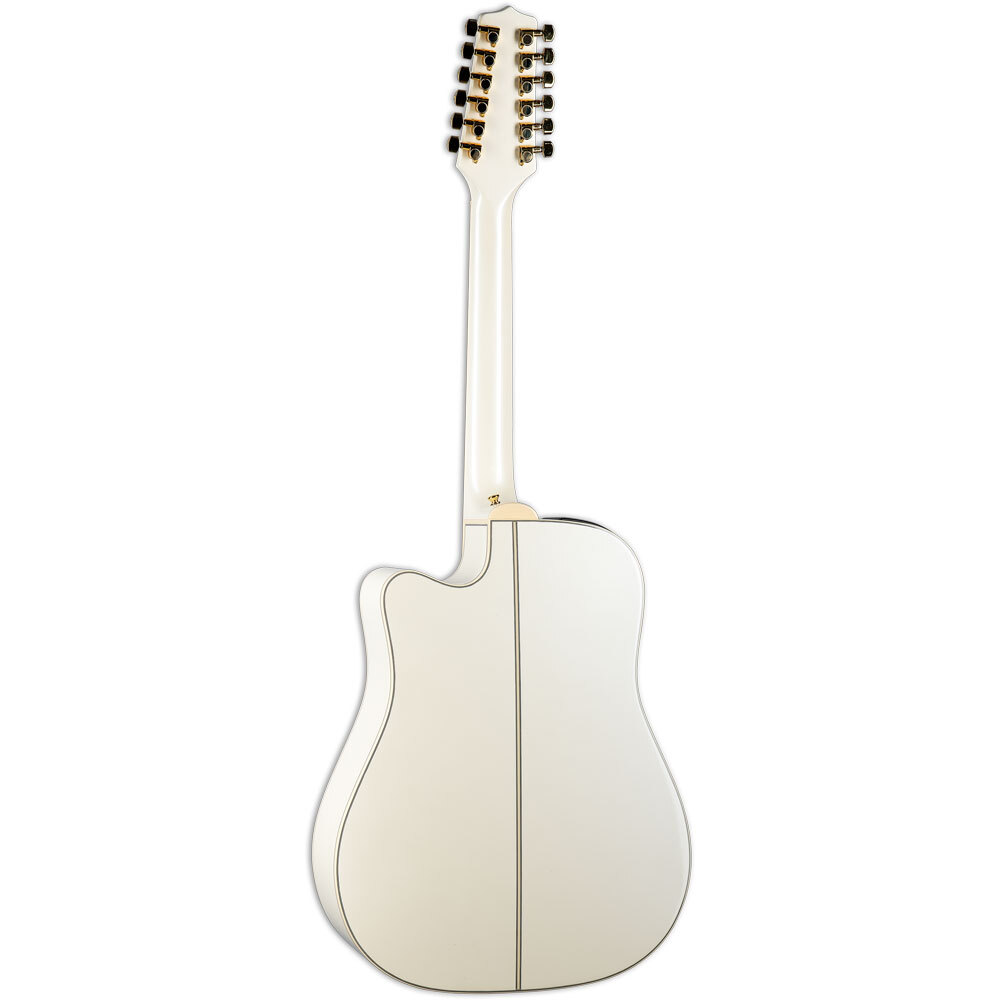
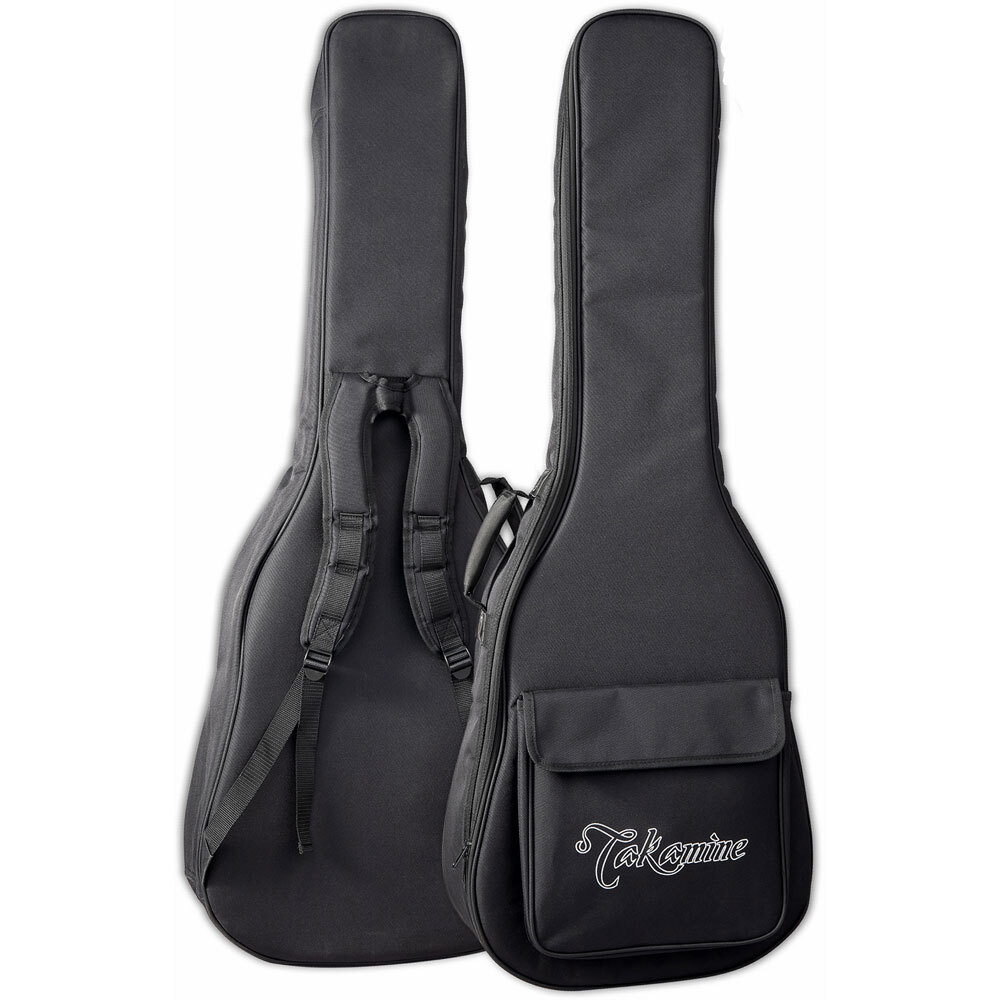
Takamine G37 Series 12-String Dreadnought AC/EL Guitar with Cutaway in Pearl White Gloss Finish
★★★★★ 4.9 Stars — Over 1,500 Google Reviews
Original price was: $1,599.00.$1,099.00Current price is: $1,099.00.
FAST
Delivery
EASY
Returns
IN HOUSE
Repairs



Check AU Shipping Cost
Pick-up from store - FREE
Free pickup from our Melbourne Store at 4 Drake Boulevard, Altona VIC 3018. Your order will typically be ready by the next business day. We recommend calling us on (03) 8360 7799 beforehand to check it's ready for collection.
International Shipping
Please proceed to checkout to see international rates and avalability.
Takamine GD37CE-12 PW — 12-String Acoustic Electric Guitar, Pearl White (TGD37CE12PW)
The Takamine GD37CE-12 PW (TGD37CE12PW) is a 12-string dreadnought cutaway acoustic electric guitar in the Takamine G-Series, finished in pearl white gloss. Spruce top, maple back and sides, mahogany neck, laurel fretboard with ivoroid binding, pearl dot inlays, abalone ring rosette, ivoroid body binding, laurel bridge with synthetic bone split saddle, gold diecast machine heads, 42.5mm nut width, 644mm scale length, and Takamine's TP-3G onboard preamp with 3-band EQ and built-in tuner. Maple back and sides give the doubled strings of a 12-string their most effective acoustic environment — bright, punchy, reflective and detailed — and the pearl white finish with gold hardware gives this instrument a stage presence that most 12-strings at this price point cannot match.
Angkor Music — What a 12-String Guitar Does, Why Maple Suits It, and What You Get With the Takamine G-Series
Three things define this instrument. First, the 12-string format. A 12-string guitar has six pairs of strings (courses) where a standard guitar has six individual strings. Each pair is played simultaneously — the four lower courses (E, A, D, G) pair a standard string with one tuned an octave higher, while the two upper courses (B and high E) are typically paired in unison. The result is an immediate, natural chorus effect — the two strings in each course vibrate at slightly different phases, creating the shimmering, full, ringing quality that defines the 12-string sound. It is the sound of George Harrison's opening to A Hard Day's Night, Jimmy Page's acoustic work on Led Zeppelin's early albums, and the sustained jangle of countless folk, country and rock recordings. For strumming and rhythm playing, a 12-string adds harmonic richness and sustain that a 6-string cannot achieve. For fingerpicking, the octave pairs create a harp-like layering of tones. Second, maple back and sides. Maple is a bright, reflective, punchy tonewood — it emphasises the upper midrange and treble frequencies where the 12-string's shimmer lives. Warmer tonewoods like mahogany and rosewood tend to soften the upper frequencies and add low-end warmth that can muddy the doubled strings of a 12-string, reducing definition between the two strings in each course. Maple's reflective character keeps each string pair distinct and bright, amplifying the shimmer and jangle that players choose a 12-string to achieve. Paired with the spruce top — clear, bright and projecting — the tonewood combination of the GD37CE-12 PW is specifically well suited to the 12-string format. Third, the G-Series value position. Takamine's G-Series is the manufacturer's entry-to-mid tier, designed to deliver Takamine's construction standards and the TP-3G electronics package at an accessible price. A 12-string at this level with a solid spruce top, maple body, Takamine's own preamp system, gold hardware and pearl white gloss finish represents genuine value for a stage-ready 12-string instrument. We stock Takamine at Angkor Music — contact us for further information.
12-String vs 6-String — Tonal Differences and Musical Uses
| Feature | 6-String Guitar | 12-String Guitar |
|---|---|---|
| Strings | 6 individual strings | 6 pairs (courses) — 12 strings total |
| Octave doubling | None | Lower 4 courses paired with octave-higher string |
| Tonal character | Direct, clear, focused | Shimmering, rich, natural chorus effect |
| Best for | Lead playing, fingerpicking, all-round use | Rhythm, strumming, lush accompaniment, folk, country, rock |
| Playing feel | Standard tension and neck profile | Higher total string tension — wider nut accommodates pairs |
Spruce Top and Maple Body — The Tonal Combination
Spruce is the most widely used acoustic guitar top tonewood, valued for its balance of stiffness and lightness that produces clear, projecting tone with good note definition. On a 12-string guitar, top clarity is important — the doubled strings need a soundboard that can differentiate between string pairs and project the shimmer and detail of the 12-string format. Combined with maple back and sides, the spruce top contributes brightness and articulation to a tonewood pairing specifically well suited to the 12-string format.
Maple Back and Sides — Why It Works for 12-String
Maple is the tonewood most closely associated with brightness, punch and articulation — its dense, hard grain reflects sound energy efficiently and emphasises the upper midrange and treble frequencies where the 12-string's shimmer lives. On a 12-string specifically, maple produces:
- String pair definition: The reflective character of maple keeps each string within a course tonally distinct rather than blending into a single undifferentiated tone
- Shimmer and jangle: Maple amplifies the upper harmonic content that gives 12-strings their characteristic ringing, shimmering quality
- Punch: Maple's quick response and strong attack give chord strums a forward, cutting presence suited to rhythm playing across acoustic and amplified contexts
- Versatility: The maple/spruce combination is tonally balanced across musical styles — bright enough for country and folk, punchy enough for rock, detailed enough for fingerstyle
Pearl White Gloss Finish, Gold Hardware and Ivoroid Binding
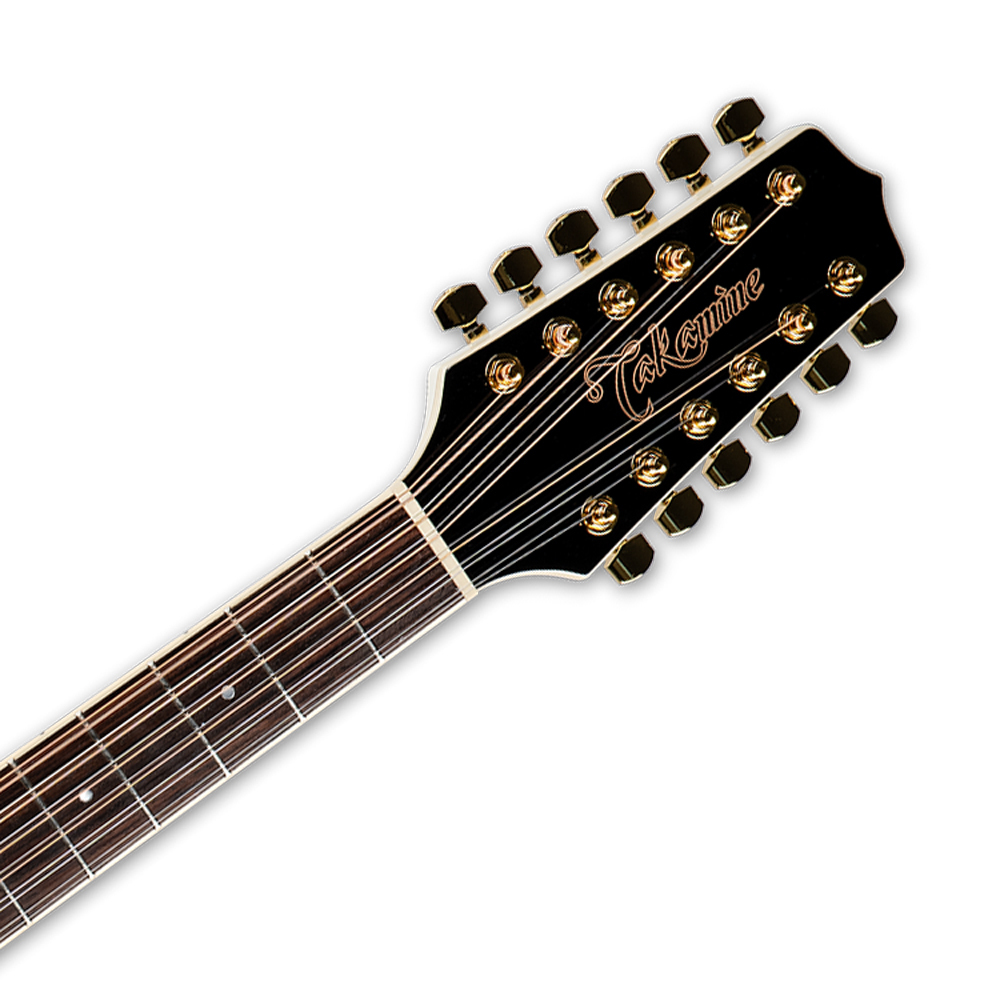
The GD37CE-12 PW's pearl white gloss finish is the visual centrepiece — an uncommon finish choice that gives the instrument immediate stage presence. The ivoroid body, fingerboard and headstock binding adds a cream-toned edge detail against the white top. Gold diecast machine heads (12 in total) coordinate with the ivoroid and white aesthetic, giving the instrument a unified, refined appearance. The abalone ring rosette around the soundhole adds the single most visually striking detail — a deep, colour-shifting abalone ring inlaid into the solid white top.
Ivoroid is a synthetic material developed as a sustainable alternative to ivory — cream-white in colour, smooth in texture, and used throughout quality acoustic instrument manufacturing for binding where real ivory would once have been used. It is both an aesthetic and an ethical choice.
Dreadnought Cutaway — Body and Upper Fret Access
The dreadnought body shape provides the large internal volume that gives acoustic guitars their maximum bass response, projection and overall loudness — the preferred shape for strumming, accompaniment and rhythm playing that 12-strings typically excel at. The cutaway removes the upper bass bout of the dreadnought to allow access to the upper frets — useful for 12-string lead passages and melodic playing in higher positions that the standard dreadnought shape restricts. The combination of dreadnought volume and cutaway upper fret access makes the GD37CE-12 PW a versatile stage and recording instrument.
Takamine TP-3G Preamp — 3-Band EQ and Built-In Tuner
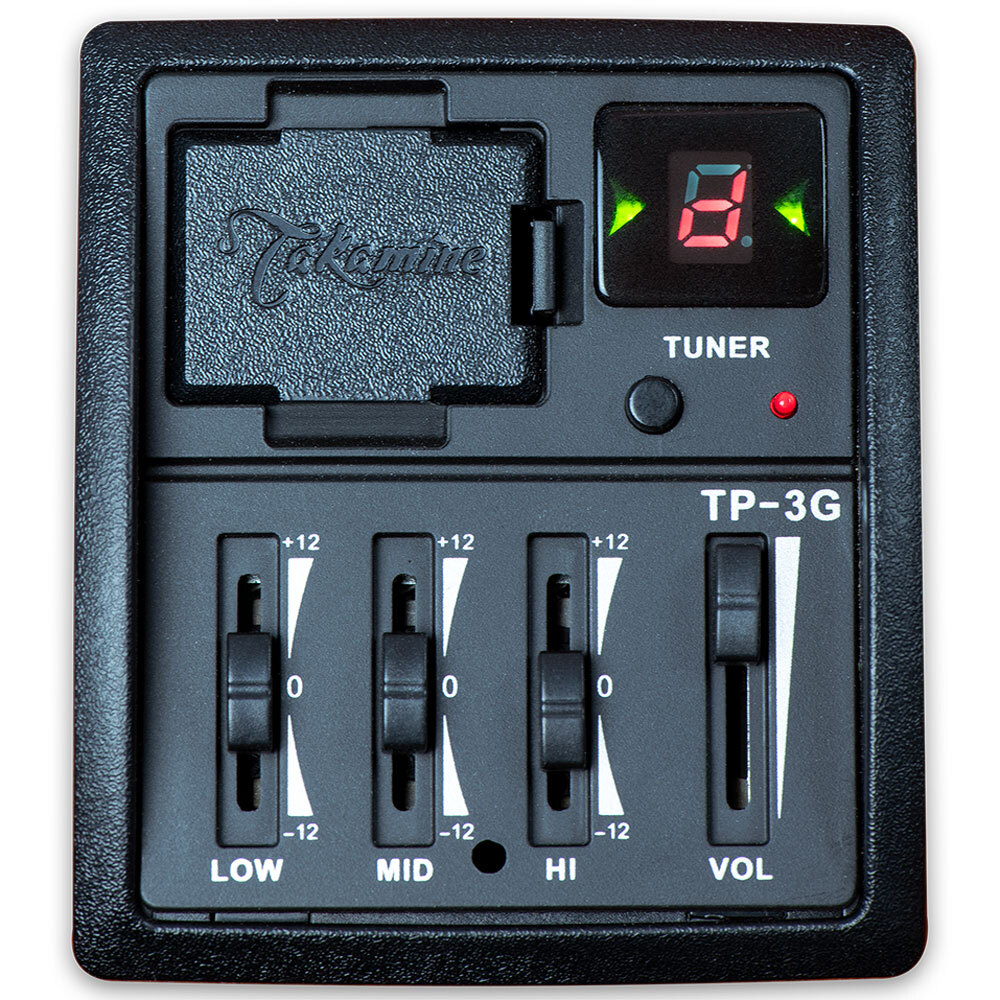
The TP-3G is Takamine's G-Series onboard preamp system — the electronics package that makes this guitar stage-ready without additional equipment:
- 3-band EQ: Independent bass, mid and treble controls allow the plugged-in tone to be shaped for the room, the PA system and the musical context — critical for 12-string playing where the bright character can need management in different acoustic environments
- Built-in chromatic tuner: Onboard tuner accessible from the preamp panel — allows silent tuning between songs without a separate pedal tuner. Essential for live 12-string performance where the doubled strings make tuning more involved than a 6-string
- Takamine system integration: The TP-3G is designed and voiced specifically for Takamine's tonewood combinations — the EQ curves are calibrated for the maple and spruce character of this guitar
Split Saddle, Laurel Bridge and 42.5mm Nut
The laurel bridge uses a synthetic bone split saddle — two saddle pieces rather than one continuous saddle. On a 12-string, intonation compensation for each course requires different saddle positions for the standard string and its octave partner. A split saddle allows independent compensation for each half of the course, producing more accurate intonation across all 12 strings than a single-piece saddle can achieve. The 42.5mm nut width provides the spacing required to accommodate 12 strings in 6 pairs comfortably.
Who Is the Takamine GD37CE-12 PW For?
- Guitar players who want to add the 12-string's shimmer, richness and fullness to their playing — for folk, country, rock and pop styles
- Gigging players who need a stage-ready 12-string with onboard EQ and tuner in a striking, visually distinctive instrument
- Players who want the specific bright, punchy tonal character of maple back and sides on a 12-string
- Players who want upper fret access on a dreadnought 12-string for lead work in higher positions
- Players drawn to the pearl white and gold aesthetic for stage presence
- 6-string players considering their first 12-string — contact us at Angkor Music for advice on the transition
Specifications
| SKU | TGD37CE12PW |
| Brand | Takamine |
| Series | G-Series |
| Type | 12-String Acoustic Electric — Dreadnought Cutaway |
| Finish | Pearl White Gloss |
| Top | Spruce |
| Back and Sides | Maple |
| Neck | Mahogany |
| Fretboard | Laurel with ivoroid binding |
| Scale Length | 644mm |
| Nut Width | 42.5mm |
| Bridge | Laurel with synthetic bone split saddle |
| Binding | Ivoroid — body, fingerboard and headstock |
| Position Inlays | Pearl dot |
| Rosette | Abalone ring |
| Machine Heads | Gold diecast — 12 tuners |
| Electronics | Takamine TP-3G preamp — 3-band EQ, built-in tuner |
| Strings | 12-string |
Expert Advice at Angkor Music
At Angkor Music Melbourne we stock Takamine acoustic and acoustic electric guitars. If you are considering the GD37CE-12 PW or want advice on 12-string playing and the transition from 6-string, contact us or visit us in Altona.
★★★★★ 4.9 Stars — Read Our 1,600+ Google Reviews →
Frequently Asked Questions
Is a 12-string guitar harder to play than a 6-string?
Yes — in a few specific ways. The doubled strings require more finger pressure to fret cleanly, and the total string tension is higher, making bending and sustained chord playing more physically demanding than a 6-string. The nut and action setup matters more on a 12-string — a well-set-up 12-string is significantly more playable than a poorly set-up one. The GD37CE-12 PW benefits from Takamine's factory setup standards. Players transitioning from 6-string typically adapt within a few weeks of regular playing.
How does the 12-string's natural chorus effect work?
Each of the lower four string pairs (E, A, D, G) has one standard-pitch string and one string tuned an octave higher. When both strings in a pair are played simultaneously, the octave creates harmonic richness and a natural layering of tones. The two strings also vibrate at very slightly different phases from each other, producing the shimmer and chorus-like quality. The upper two pairs (B and high E) are typically tuned in unison, adding thickness and body rather than octave depth.
What is the split saddle on the bridge and why does it matter?
A split saddle is two separate saddle pieces rather than one continuous piece. On a 12-string guitar, intonation compensation (the slight forward or backward positioning of each saddle point to ensure accurate pitch across the fretboard) needs to be different for the standard string and its octave or unison partner in each course. A split saddle allows independent compensation for each half, producing more accurate intonation across all 12 strings. It is a meaningful acoustic detail on a 12-string that a single-piece saddle cannot replicate as accurately.
What does the Takamine TP-3G preamp give me for live performance?
The TP-3G provides 3-band EQ (bass, mid, treble) for shaping the amplified tone to suit the room and PA system, and a built-in chromatic tuner for silent stage tuning without a separate tuner pedal. For live 12-string performance specifically, the EQ is important — 12-string guitars can have a pronounced upper midrange character when amplified that benefits from EQ adjustment depending on the room. The onboard tuner is also practically important on a 12-string where tuning 12 strings accurately between songs is more time-consuming than tuning 6.
What style of music suits a 12-string guitar?
The 12-string excels in any style that benefits from harmonic richness and natural shimmer — folk, country, acoustic rock, singer-songwriter material and pop. It is the defining instrument of the British Invasion jangle sound, the acoustic dimension of classic rock, and the backbone of much contemporary folk and Americana. It is less suited to styles requiring precise lead playing at speed, where the doubled strings add complexity without clear tonal benefit.
Additional information
| Weight | 0.0000 kg |
|---|---|
| Type | Electro-Acoustic Guitar |
| String Configuration | 6 String |
Related Items & Accessories
Related products
-
17% OFF
RRP $299.00
Save $50.00
Sale!
 SKU: 11205-03
Seymour Duncan STHR-1b Hot Rails Lead for Tele Guitar Bridge Pickup Black
Original price was: $299.00.$249.00Current price is: $249.00.In Stock -
10% OFF
RRP $107.00
Save $11.00
 SKU: 14010301 – SatinChrome
Schaller New S Locks (Pair) Satin Chrome 14010301 Strap Locks / security Locks
Original price was: $107.00.$96.00Current price is: $96.00.Out of stock -
8% OFF
RRP $92.00
Save $7.00
Sale!
 SKU: 14010601 – Ruthenium
Schaller New S Locks (Pair) Ruthenium 14010601 Strap Locks / security Locks
Original price was: $92.00.$85.00Current price is: $85.00.In Stock -
19% OFF
RRP $779.00
Save $150.00
Sale!
 SKU: 11208-02-B
Seymour Duncan Hot Rails Strat Guitar Pickup Set – Black 11208-02-B
Original price was: $779.00.$629.00Current price is: $629.00.In Stock -
26% OFF
RRP $4,699.00
Save $1,200.00
Sale!
 SKU: 041152
GODIN SUMMIT CLASSIC (CT) HB CREME BRULEE with Gig bag
Original price was: $4,699.00.$3,499.00Current price is: $3,499.00.In Stock